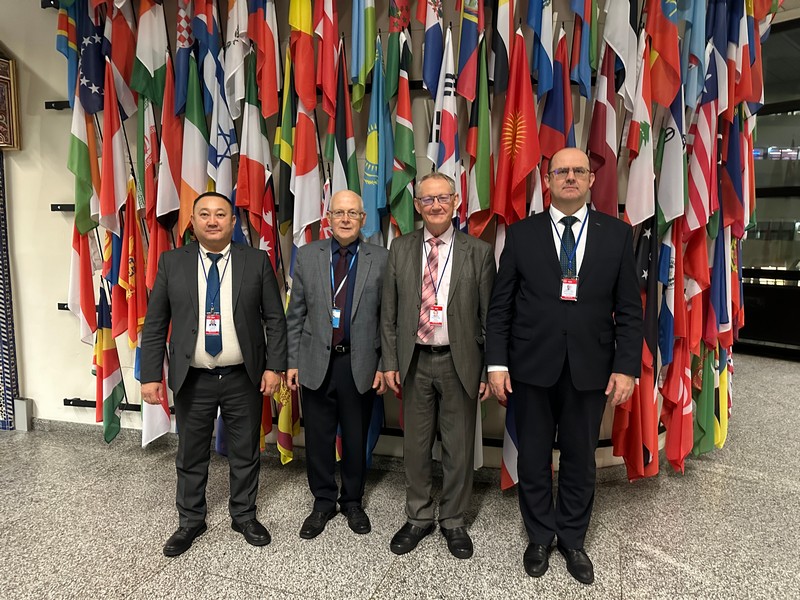
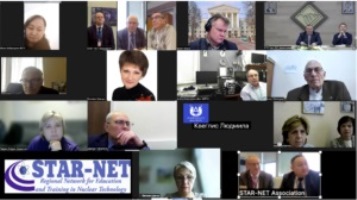
The XI General Assembly of the Regional Network for “Education and Training in Nuclear Technologies – STAR-NET ” took place.
Vladimir Shevchenko, Rector of the National Research Nuclear University MEPhI and President of STAR-NET, noted in his speech:
He also pointed out the need to attract the most advanced and talented applicants to the field of nuclear technology, while competing with such popular training areas as IT, fintech and classical engineering.
Andrey Timoshchenko from BSU, Andrey Kosilov from the National Research Nuclear University MEPhI, Anatoly Tolstenkov from the STAR-NET administrative group, Aibek Akaev from EKTU, Volodimir Kravchenko from NUOP and others also spoke and presented different issues related to the network activities and further cooperation.
The meeting participants summed up the results of ten years of joint work and shared their experience in organizing cooperation between universities and nuclear industry organizations. They noted that the key factors for successful collaboration are:
- Understanding the importance of cooperation between the leading universities in the region in providing qualified personnel to enterprises engaged in the peaceful use of atomic energy. T
- he direct participation of the top management of universities in the creation and operation of the network.
- Support from the IAEA and industry.
- Sufficient financial resources to support the network’s activities.
- The interest in networking from the teaching staff – to support educational courses and events through information and methodological exchange.
- Uninterrupted operation of the STAR-NET LMS educational platform.
- Cooperation with other educational networks and organizations.
The participants proposed to intensify cooperation between partner universities: to hold more joint events on topical issues of nuclear energy – webinars, conferences for young scientists and students; to develop a dual degree system among the universities of the network; to continue work on the development and implementation of curricula and courses; to continue the practice of joint distance learning courses and the exchange of experience using the learning management platform STAR-NET LMS; to create joint Master’s degree programmes – nuclear power engineering, nuclear technology management (INMA), etc.; to conduct joint research projects; to pay special attention to career guidance work with schoolchildren and students.
Georgy Tikhomirov, Deputy Director of the Institute of Nuclear Physics and Technology, made a proposal to include the International Summer School on Engineering Computer Modeling in Nuclear Technologies, which will traditionally be held at MEPhI in the summer of 2026, in the list of STAR-NET events, and also invited colleagues to participate in a scientific and technical seminar on nuclear reactor physics, which will be held at the Volga university recreation center next September.
The STAR-NET network effectively cooperates with the IAEA, the CTBTO and international nuclear education networks, complementing existing international initiatives and focusing on education and training of specialists, pays attention to issues related to nuclear technology, education, training of specialists and work with schoolchildren. The participants proposed to further develop this area of cooperation, in particular, to consider participation in the new IAEA/INPRO collaboration project “Developing Competencies in the field of strategic planning of sustainable nuclear energy through educational programs” and in other events dedicated to nuclear education and nuclear knowledge management.
The General Assembly has appointed the governing bodies of STAR-NET: Vladimir Shevchenko (NRNU MEPhI) was elected president of the network, Andrei Timoshchenko (BSU, Belarus) – Vice President. The members of the Presidium are: Gor Vardanyan (NPUA), Huseyn Mikayil Mamedov (BSU, Azerbaijan), Vadim Bogush (BSUIR), Aybek Akayev (EKTU), Sergey Dmitriev (NNSTU), Volodimir Kravchenko (NUOP) and Rashid Eshburiev (SamSU)